NEET Counselling Process Explained Step by Step
Getting a NEET rank is only half the journey. The real admission happens through NEET UG counselling, where seats are distributed to students based on rank, category, choices, and availability. Many students lose seats not because of low marks, but because they do not understand the counselling process properly.
This article explains NEET UG 2026 counselling conducted by MCC (Medical Counselling Committee) for All India Quota, Central Universities, AIIMS, JIPMER, Deemed Universities, and Delhi University colleges, in detail. Also, read about the other associated steps like registration, seat matrix, etc.
What is NEET UG 2026 Counselling?
NEET UG Counselling is a centralized online admission process through which medical and dental seats are allotted after the NEET UG 2026 results. The counselling is conducted by DGHS (Directorate General of Health Services) on behalf of MCC. The counselling decides:
- Which college you get
- Which course you get (MBBS / BDS / BSc Nursing)
- Under which quota and category you are admitted
Without participating in counselling, no admission is possible, even if your NEET score is very high.
Who conducts NEET UG 2026 Counselling?
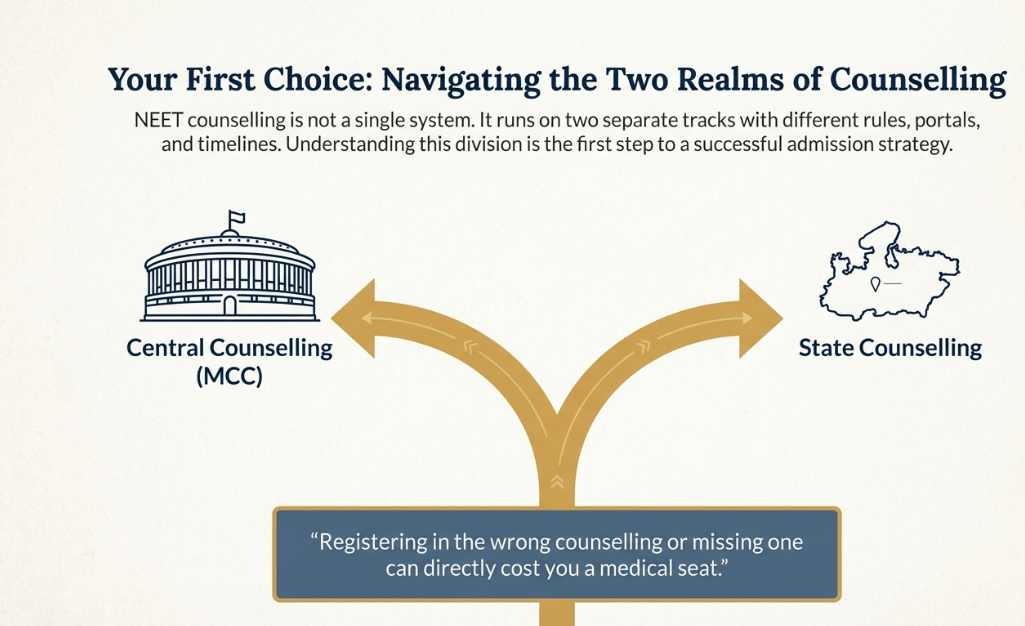
NEET UG 2026 counselling in India is not handled by a single authority. Instead, it is conducted in two parallel systems, depending on the type of seat you are applying for. One system is managed at the national level by the Medical Counselling Committee (MCC), and the other is managed at the state level by individual State Counselling Authorities. Understanding this division is extremely important, because registering in the wrong counselling or missing one can directly cost you a medical seat.
In simple words, MCC counselling handles national-level and central institution seats, while State counselling handles state quota and private college seats. These two processes run separately, have different rules, different portals, and sometimes even different timelines.
Two Types of NEET UG 2026 Counselling
NEET UG Counselling is of two types and are conducted under the following two broad categories:
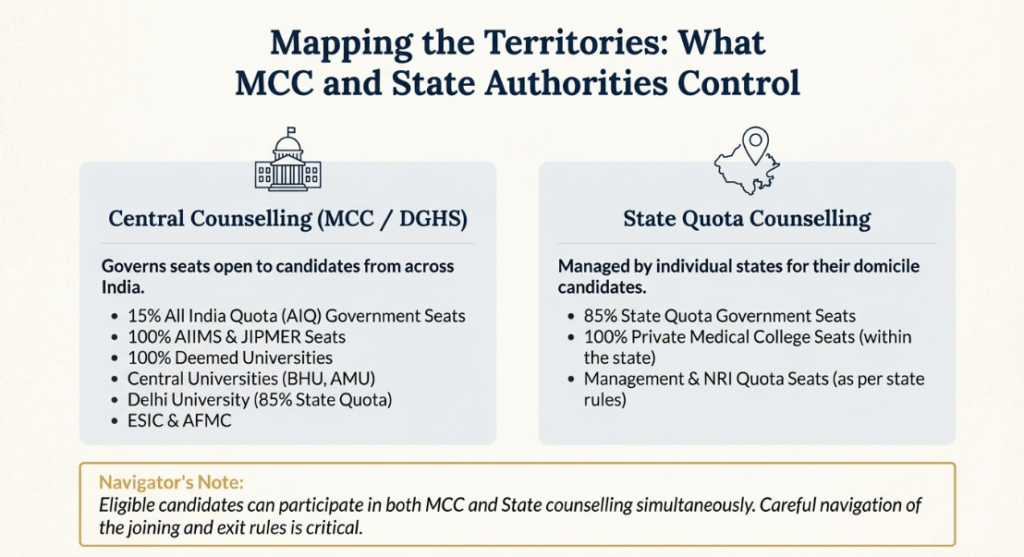
- Central Counselling (MCC / DGHS Counselling): Conducted for All India Quota seats, central institutions, AIIMS, JIPMER, Deemed Universities, and some special institutions.
- State Counselling (State Quota Counselling): Conducted individually by each state or union territory for state quota government seats and private medical colleges within that state.
MCC (Medical Counselling Committee) Counselling – Central Level
MCC counselling is conducted by the Directorate General of Health Services (DGHS) on behalf of the Government of India. This counselling is completely online and is meant for seats that are not controlled by state governments. If a seat is under MCC, no state authority has the power to allot it.
MCC counselling covers seats that are open to candidates from across India (subject to eligibility), and the admission is done strictly based on All India Rank (AIR) and central reservation rules. The table below shows the types of seats included under MCC counselling and their coverage.
| Seat Category | Coverage |
| All India Quota (AIQ) | 15% of Government Medical & Dental seats |
| AIIMS | 100% seats |
| JIPMER | 100% seats |
| BHU & AMU | 100% MBBS / BDS seats |
| Delhi University | 85% State Quota + Institutional seats |
| ESIC Medical Colleges | All India quota + IP quota seats |
| Jamia Millia Islamia | Faculty of Dentistry + 5% internal quota |
| Deemed Universities | 100% seats |
| AFMC Pune | Through MCC + separate AFMC selection process |
State Quota Counselling – State Level
State quota counselling is conducted by the respective State Governments or designated counselling bodies. Each state has its own counselling portal, rules, reservation policies, domicile conditions, and timelines. MCC has no role in these admissions.
State counselling mainly focuses on students who want admission within their home state, especially under domicile-based reservations.
| Seat Category | Coverage |
| State Quota Government Seats | 85% of Government Medical & Dental seats |
| Private Medical Colleges | 100% seats (except Deemed Universities) |
| Management Quota | As per state rules |
| NRI Quota | As per state rules |
| State Institutional Quota | As notified by the state |
NEET UG 2026 Counselling Eligibility Criteria
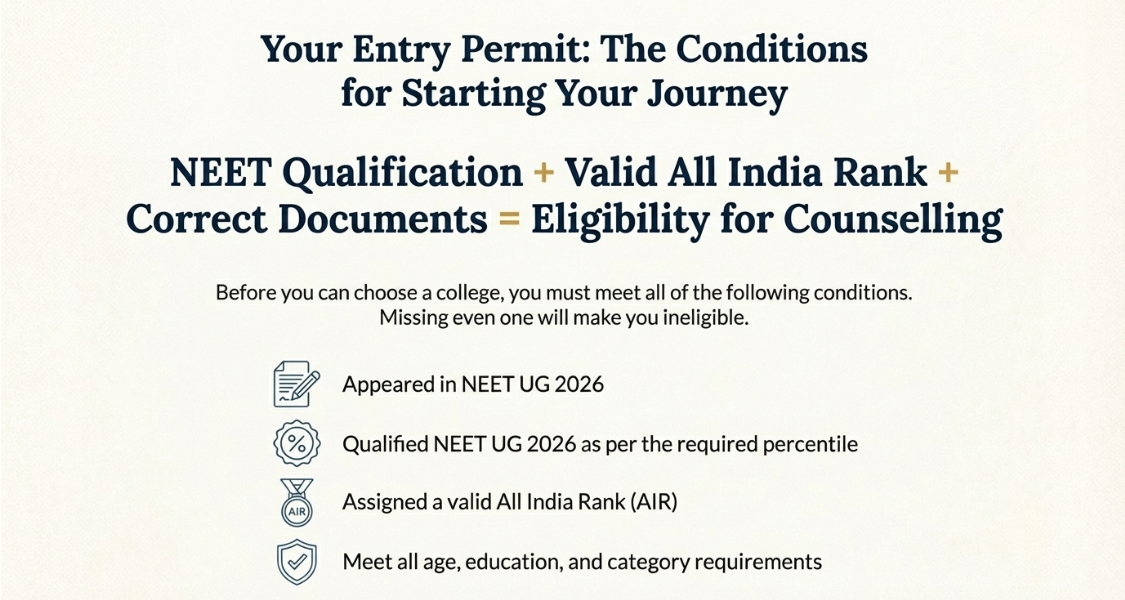
Before a candidate can even think about college choices or counselling rounds, the basic eligibility conditions for NEET UG 2026 counselling must be fulfilled. Counselling authorities do not allow participation just because someone appeared for the exam. A candidate must qualify NEET UG, obtain a valid rank, and satisfy age, education, and category-related conditions. If even one requirement is missing, the candidate is considered ineligible, no matter how high the score is. In simple terms, NEET qualification + valid All India Rank + correct documents = Eligibility for NEET Counselling.
Basic Eligibility Conditions for NEET UG 2026 Counselling
To participate in NEET UG 2026 counselling, a candidate must meet all of the following conditions:
- Must have appeared in NEET UG 2026
- Must have qualified NEET UG 2026 as per the required percentile
- Must have been assigned a valid All India Rank (AIR)
- Must satisfy age criteria and educational qualifications as prescribed
- Must meet the category-wise qualifying percentile, if claiming reservation
- Only candidates fulfilling these conditions are included in the counselling merit list.
Qualifying Scores in NEET UG – What does “Qualify” mean?
Qualifying NEET UG does not mean getting a fixed number of marks. Instead, qualification is based on a percentile system, which compares a candidate’s performance with others who appeared in the exam. A candidate is considered qualified only if their percentile is equal to or above the minimum cutoff decided for that year. This qualifying status is essential because only qualified candidates are assigned an All India Rank, and without an AIR, counselling participation is not allowed.
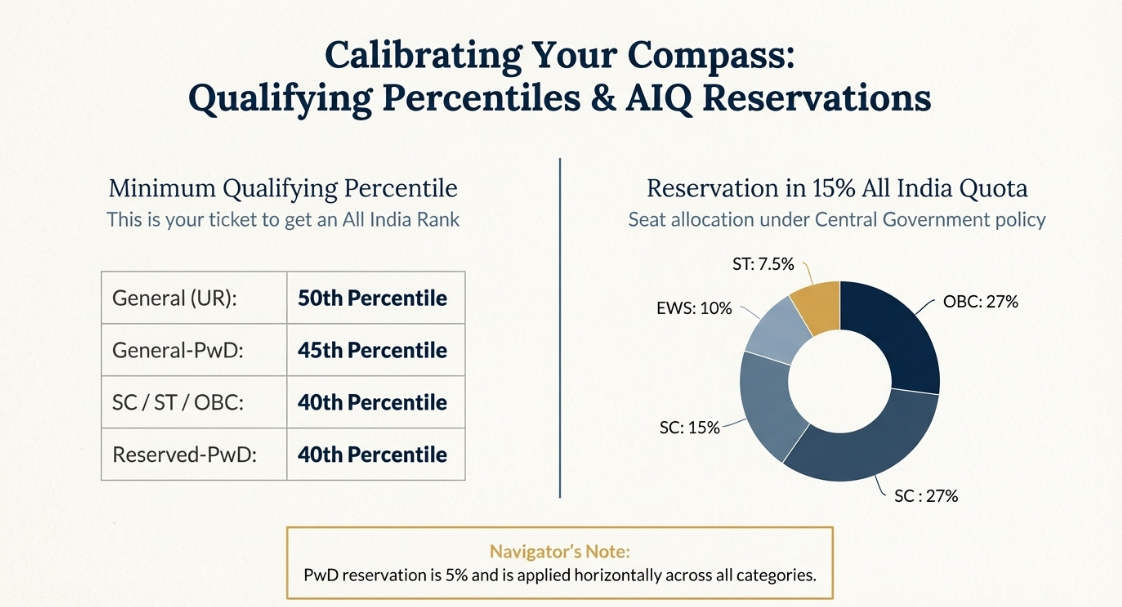
The minimum qualifying percentile for NEET UG 2026 is decided category-wise. These percentiles are applied uniformly across the country for counselling eligibility.
| Category | Minimum Qualifying Percentile |
| General (UR) | 50th Percentile |
| General – PwD | 45th Percentile |
| SC / ST / OBC | 40th Percentile |
| SC-PwD / ST-PwD / OBC-PwD | 40th Percentile |
Minimum Qualifying Percentile for NEET UG 2026
The minimum qualifying percentile for NEET UG 2026 is decided category-wise. These percentiles are applied uniformly across the country for counselling eligibility. Candidates scoring below the required percentile in their respective category are not eligible for counselling, even if they are close to the cutoff marks.
| Category | Minimum Qualifying Percentile |
| General (UR) | 50th Percentile |
| General – PwD | 45th Percentile |
| SC / ST / OBC | 40th Percentile |
| SC-PwD / ST-PwD / OBC-PwD | 40th Percentile |
Eligibility Based on All India Rank (AIR)
Once the NEET result is declared, the exam authority prepares an All India Merit List. Every qualified candidate is assigned an All India Rank, which becomes the foundation of the entire counselling process. All candidates who have a valid AIR, and meet the qualifying percentile are considered eligible for counselling, subject to specific rules of the counselling authority.
However, in some cases, domicile-based restrictions may apply. For example, participation in 15% All India Quota seats may exclude certain candidates based on state-specific policies, if applicable at that time.
Reservation in 15% All India Quota (AIQ) Seats
Reservation in the 15% All India Quota is implemented as per Central Government reservation policies, not state rules. This means the category certificates must follow central formats and central category lists, especially for OBC and EWS candidates. The reservation ensures fair representation of different social categories across government medical and dental colleges in India. PwD reservation is applied across all categories, meaning PwD seats are carved out horizontally from UR, SC, ST, OBC, and EWS categories.
| Category | Reservation Percentage |
| Scheduled Caste (SC) | 15% |
| Scheduled Tribe (ST) | 7.5% |
| Other Backward Classes (OBC – Central List) | 27% |
| Economically Weaker Section (EWS) | 10% |
| Persons with Disabilities (PwD) | 5% (horizontal) |
NEET UG 2026 Counselling Rounds Explained
NEET UG 2026 counselling conducted by MCC is not a single-day or single-round process. It happens in multiple structured rounds, each designed to fill seats in a fair and systematic way. Many students wrongly assume that if they do not get a seat in the first round, their chances are over. In reality, a large number of seats are allotted in later rounds, especially in Round 2, Mop-Up, and Stray Vacancy rounds.
Understanding how many rounds are conducted and how each round functions is extremely important, because rules related to exit, upgradation, and forfeiture change from round to round.
How many counselling rounds are conducted by MCC?
The number of rounds varies depending on the type of institution and seat category. MCC conducts counselling separately for different seat pools, but the overall structure remains predictable every year. The counselling officially ends after the Stray Vacancy Round, and no admissions are allowed beyond that point.
| Seat Type | Number of Rounds |
| All India Quota (15%) | 2 Rounds |
| Central Universities | 2 Rounds |
| Deemed Universities | 3 Rounds |
| AIIMS / JIPMER | 2 Rounds |
| Mop-Up Round | Conducted separately |
| Stray Vacancy Round | Final round |
Step-by-Step NEET UG 2026 Counselling Process
The NEET UG 2026 counselling process follows a strict, predefined sequence, and every step is interconnected. A candidate cannot skip any stage and move ahead. Registration, fee payment, choice filling, seat allotment, and reporting are all mandatory procedural stages under MCC NEET UG counselling. Any error, delay, or misunderstanding at any stage can result in loss of eligibility or cancellation of the allotted seat.
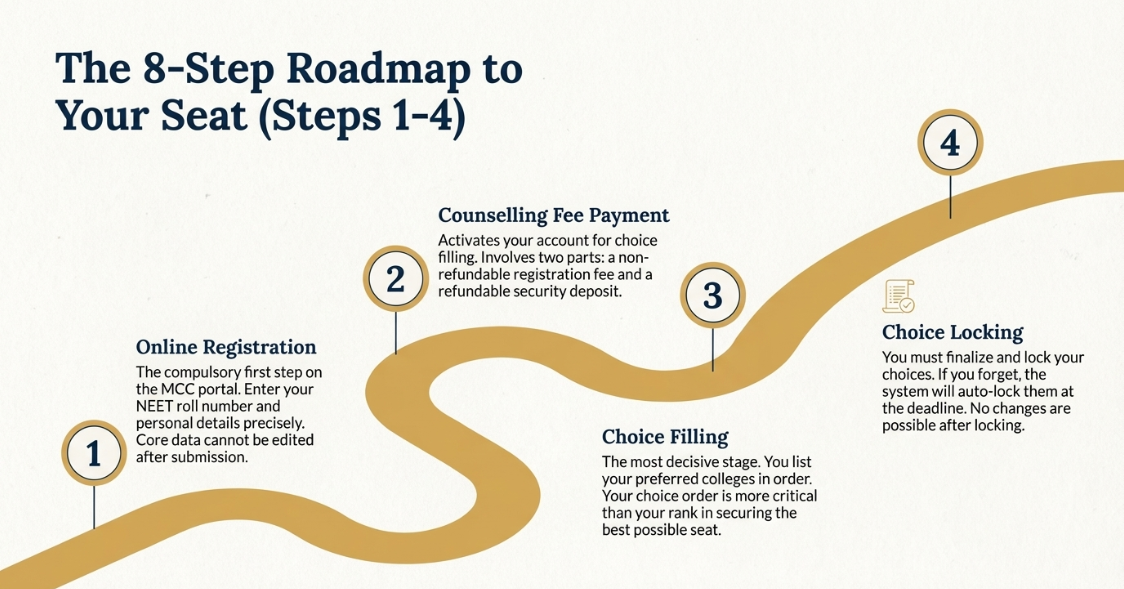
Step 1: Online Registration for NEET UG 2026 Counselling
Online registration is the first and compulsory step in the NEET UG counselling process. Without completing registration on the MCC portal, a candidate cannot participate in choice filling for NEET UG counselling or be considered for seat allotment under AIQ or Deemed Universities. Registration is conducted only online, and MCC does not accept any offline applications. During NEET UG 2026 counselling registration, candidates must complete the following actions:
- Enter NEET UG 2026 roll number, application number, and security pin
- Fill personal details exactly as mentioned in NEET records
- Select counselling type:
- All India Quota (AIQ)
- Deemed Universities
- Both AIQ and Deemed Universities
- Create login credentials for MCC NEET UG counselling portal
Once the registration form is submitted:
- Core personal data such as name, date of birth, and category cannot be edited
- Any mismatch between registration details and original documents may lead to rejection during document verification
Step 2: Counselling Fee Payment for NEET UG 2026
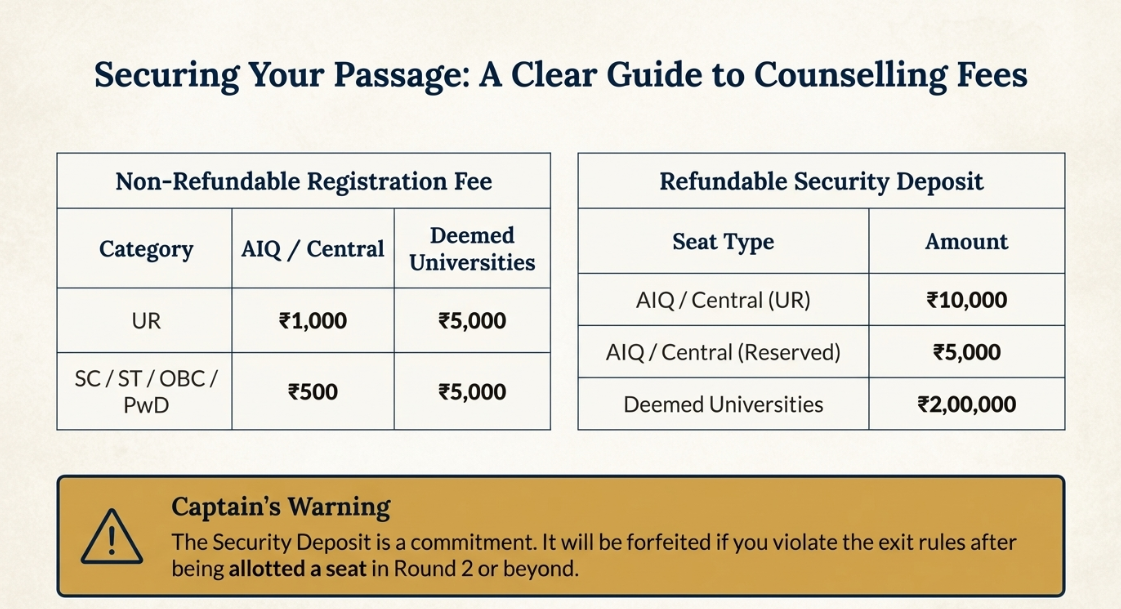
After successful registration, candidates must complete counselling fee payment for NEET UG 2026. Fee payment is mandatory to activate the account for choice filling in NEET UG counselling. MCC collects two different types of fees, and both must be paid to participate.
Non-Refundable Registration Fee (NEET UG Counselling)
This fee is charged for participation in the counselling process and is not refunded under any circumstances.
| Category | AIQ / Central | Deemed Universities |
| UR | ₹1,000 | ₹5,000 |
| SC / ST / OBC / PwD | ₹500 | ₹5,000 |
Refundable Security Deposit (NEET UG Counselling)
This amount acts as a security commitment and is refunded or forfeited based on the candidate’s actions during counselling rounds.
| Seat Type | Amount |
| AIQ / Central (UR) | ₹10,000 |
| AIQ / Central (Reserved) | ₹5,000 |
| Deemed Universities | ₹2,00,000 |
Security deposit rules are linked to:
- Joining or not joining an allotted seat
- Exit rules of different NEET UG counselling rounds
- Participation in Mop-Up and Stray Vacancy rounds
Step 3: Choice Filling for NEET UG Counselling
Choice filling is the most decisive stage of the NEET UG counselling process. This step determines which colleges and courses a candidate is willing to accept. MCC seat allotment is based more on choice order than raw NEET marks.
During choice filling for NEET UG 2026 counselling, candidates must:
- Select MBBS / BDS colleges and courses from the available list
- Arrange choices from highest preference to lowest preference
Read: How to choose the right medical college during NEET Counselling?
Important points related to choice filling for NEET UG counselling:
- There is no limit on the number of choices that can be filled
- Seat allotment follows the rule: better choice + available seat + eligible rank
- Incorrect or careless choice order can block better colleges
- Candidates should prepare an offline choice filling strategy using previous year cut-offs
Step 4: Choice Locking in NEET UG Counselling
Choice locking is the step where the candidate confirms the final list of preferences submitted for seat allotment. Only locked choices are considered during MCC seat allocation.
Key rules for choice locking in NEET UG counselling:
- Choices must be locked before the deadline
- If not locked manually, the system performs automatic locking
- After locking, no editing or reordering is allowed
- Locked choices are final for that counselling round
Candidates should:
- Download the locked choice list PDF
- Preserve it for future reference during seat allotment and reporting
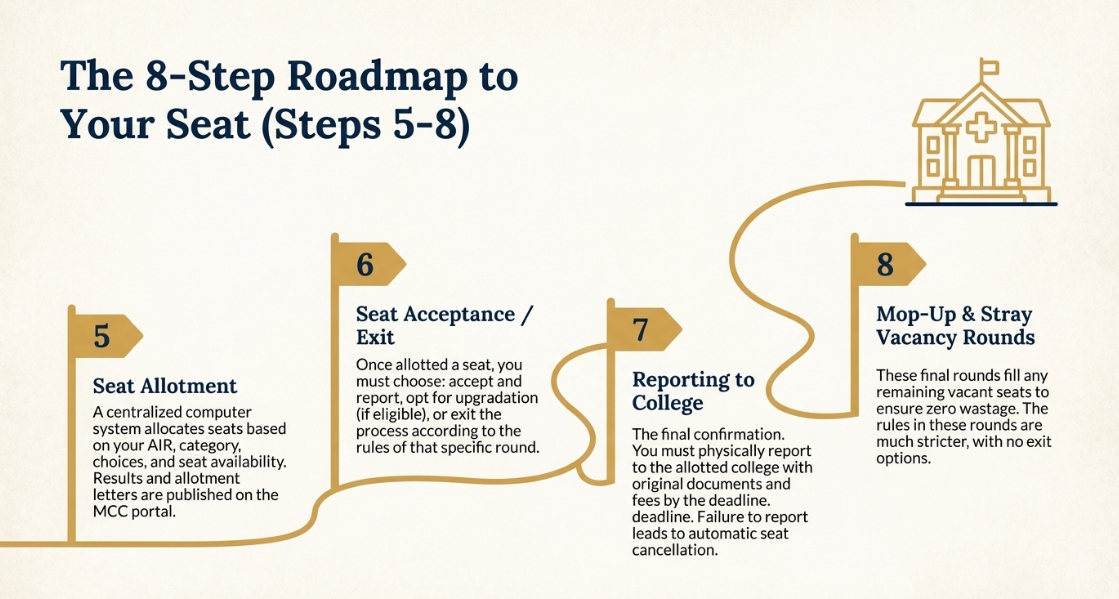
Step 5: Seat Allotment Process in NEET UG Counselling
Seat allotment is conducted through a centralized computerized system operated by MCC. All registered candidates are processed together, and seats are allotted based on merit and preferences.
Seat allotment for NEET UG 2026 is based on:
- NEET All India Rank (AIR)
- Category and reservation eligibility
- Locked choices submitted by the candidate
- Seat availability at the time of allotment
Read: Understanding NEET UG Seat Matrix
After allotment, MCC publishes:
- A round-wise seat allotment result
- An individual NEET UG seat allotment letter
The seat allotment letter contains:
- Name of allotted college
- Course (MBBS / BDS)
- Reporting instructions and timelines
Step 6: Seat Acceptance or Exit Options in NEET UG Counselling
After seat allotment, candidates must choose how to proceed under NEET UG counselling rules. Options vary depending on the counselling round.
Available options after seat allotment:
- Accept the seat and proceed for reporting
- Choose upgradation for a higher preference in the next round (if eligible)
- Exit the counselling process as per round-specific exit rules
Important rules related to exit and upgradation:
- Free exit is allowed only in Round 1
- Exiting after Round 1 may lead to forfeiture of security deposit
- Joining a seat may block eligibility for certain future rounds
Step 7: Reporting to the Allotted College
Reporting to the allotted college is the final step of seat confirmation. A seat is considered valid only after physical reporting and document verification.
Documents required during reporting:
- Original academic certificates
- NEET UG admit card and scorecard
- MCC seat allotment letter
- Valid photo identity proof
- Category certificate / PwD certificate (if applicable)
- Tuition fee and admission charges
Check Complete List of Documents Required for NEET UG Counselling
Rules related to reporting:
- Reporting must be done within the prescribed deadline
- Failure to report results in automatic seat cancellation
- In certain cases, security deposit may be forfeited
Step 8: Mop-Up Round and Stray Vacancy Round in NEET UG Counselling
After completion of Round 2, any vacant seats are filled through the Mop-Up Round. These rounds are conducted strictly to ensure zero seat wastage.
Key features of Mop-Up and Stray Vacancy rounds:
- Mop-Up round is conducted by MCC for vacant AIQ and Deemed seats
- No free exit is allowed once a seat is allotted in Mop-Up
- Stray Vacancy round is conducted directly by colleges
- No fresh registration is permitted in Stray Vacancy round
- Seat allotment is done from the MCC-provided merit list
The Stray Vacancy round represents the final stage of NEET UG 2026 admissions, after which counselling is officially closed.
Important Rules About Exit & Forfeiture in NEET UG 2026 Counselling
Exit and forfeiture rules define whether a candidate can leave an allotted seat and what happens to the security deposit and future eligibility. These rules vary from round to round and are among the most misunderstood aspects of NEET UG counselling. Once a candidate violates exit rules, penalties such as forfeiture of security deposit or disqualification from further rounds may apply. Understanding exit rules is essential before accepting or joining any seat under MCC NEET UG counselling.
| Counselling Round | Exit Rule |
| Round 1 | Free exit allowed |
| Round 2 | Exit with forfeiture of security deposit |
| Mop-Up Round | No exit allowed |
| Stray Vacancy Round | No exit allowed |
Key exit-related rules in NEET UG counselling:
These rules are strictly enforced to prevent seat blocking and ensure fair distribution of medical seats under NEET UG 2026 counselling.
- Free exit means the candidate can leave without losing the security deposit
- Free exit is allowed only in Round 1, before joining the allotted seat
- Exiting after Round 2 results in forfeiture of security deposit
- No resignation or exit is permitted after Mop-Up or Stray Vacancy allotment
- Once a Round 2 seat is joined, the candidate:
- Cannot leave that seat
- Cannot participate in any other counselling (state or central)
- Cannot upgrade or switch colleges
For detailed guidance on counseling and seat allotment, check our NEET Counseling Guide or explore Top Government Medical Colleges.
📩 Email: info@collegeustad.com
🌐 Visit Our Website: www.collegeustad.com
💬 Join Our WhatsApp Group: Click Here to stay updated with NEET UG 2025 news and counseling tips.
FAQs
What is NEET UG 2026 counselling?
NEET UG 2026 counselling is the centralized admission process through which MBBS, BDS, and BSc Nursing seats are allotted after NEET results. Seat allotment depends on NEET rank, category, choices filled, and seat availability.
Is qualifying NEET UG enough to get an MBBS or BDS seat?
No. Qualifying NEET UG only makes a candidate eligible for counselling. Admission is possible only after participating in NEET UG counselling and being allotted a seat.
Who conducts NEET UG 2026 counselling?
NEET UG 2026 counselling is conducted by: MCC (Medical Counselling Committee) for All India Quota, AIIMS, JIPMER, Central Universities, Deemed Universities, ESIC, AFMC, and Delhi University. State Counselling Authorities for state quota and private medical college seats
Can I participate in both MCC and State counselling?
Yes. Eligible candidates can participate in both MCC counselling and State counselling simultaneously, provided they follow the rules of exit and joining carefully
What happens if I do not register for NEET UG counselling?
If you do not register for counselling, you will not be considered for seat allotment, even if your NEET rank is very high
What is choice filling in NEET UG counselling?
Choice filling is the process where candidates select and arrange medical colleges and courses in order of preference. Seat allotment is based more on choice order than marks, so correct choice filling is crucial.
Can I change my choices after locking them?
No. Once choices are locked, they cannot be edited or rearranged for that counselling round
What is a free exit in NEET UG counselling?
Free exit means a candidate can leave the counselling process without losing the security deposit. Free exit is allowed only in Round 1, before joining the allotted seat.
What happens if I join a seat in Round 2?
Once a Round 2 seat is joined, the candidate: cannot leave that seat, cannot participate in any other counselling (state or central), and cannot upgrade or switch colleges
Is reporting to the allotted college mandatory?
Yes. Reporting with original documents within the given deadline is mandatory. Failure to report results in automatic cancellation of the allotted seat