AIQ vs State Quota Seats: Key Differences Explained
After NEET results, students must take part in counselling to get an MBBS seat. During this stage, two terms are used very often- AIQ seats and State Quota seats. These two decide where you can apply, who you compete with, and how high the cut-off will be. Understanding this difference is necessary before filling any choices.
What does “Quota” mean in NEET Counselling?
In NEET Counselling, “quota” simply means how medical seats are divided for admission. All MBBS seats in government colleges are not filled in the same way. Some seats are kept open for students from all over India, while others are reserved mainly for students from a particular state. This division exists to balance two things:
- Merit at the national level
- Healthcare needs of individual states
Because of this, government medical college seats are mainly divided into All India Quota (AIQ) and State Quota seats.
Also Read: Types of NEET Counselling
What is AIQ (All India Quota)?
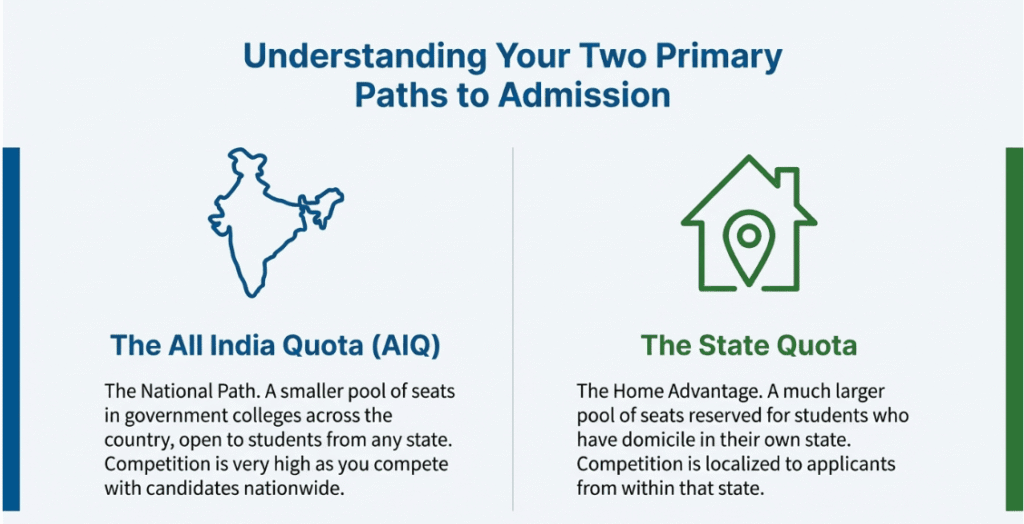
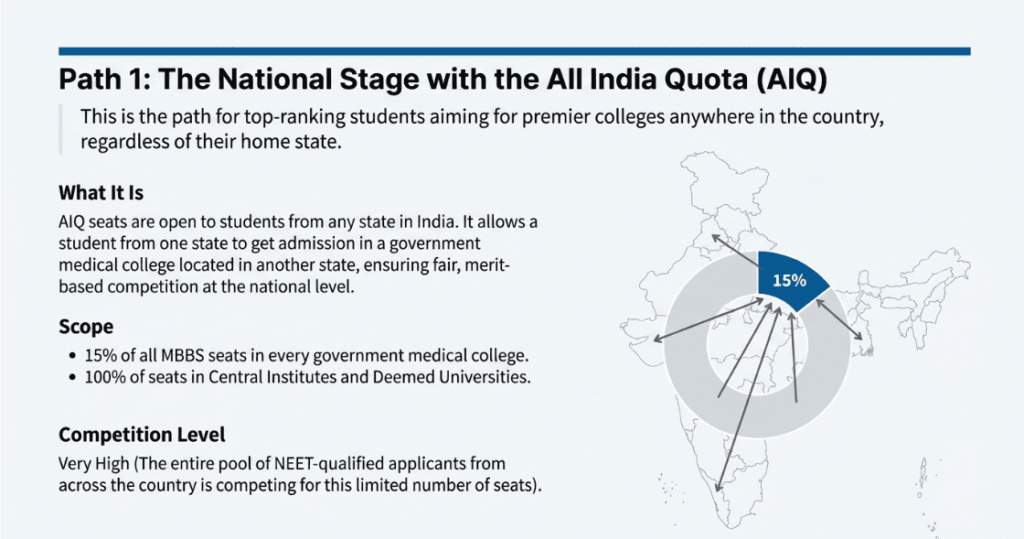
AIQ stands for All India Quota. These are medical seats that are kept open for students from any state in India, regardless of where they studied or where they live. AIQ allows a student from one state to get admission in a government medical college located in another state. This quota is created to ensure fair, merit-based competition at the national level.
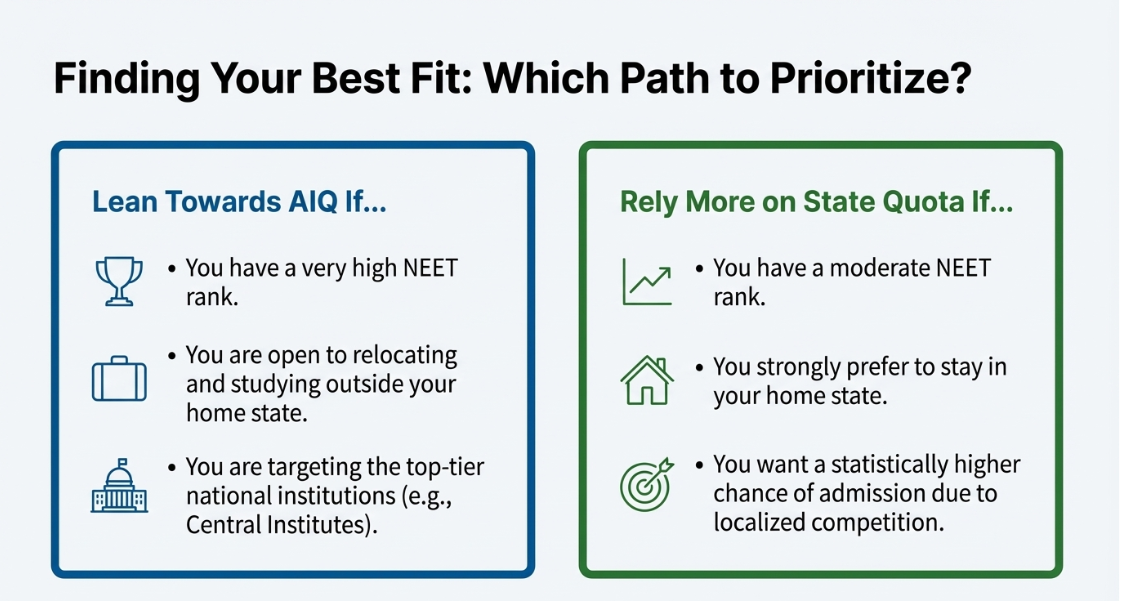
AIQ seats are part of government medical colleges and central institutions. Because students from across the country compete for these seats, the cut-off ranks are usually high. AIQ is mainly preferred by students with good NEET ranks who are willing to study outside their home state.
How many seats come under AIQ?
In every government medical college, 15% of the total MBBS seats are reserved under the All India Quota. These seats are taken out of the state pool and added to a national-level counselling system. Apart from this, AIQ counselling also includes 100% seats of central institutes and deemed universities. Because the number of AIQ seats is limited and competition is national, seat availability is lower compared to state quota. This is one of the main reasons why AIQ cut-offs are higher.
Check Complete List of Documents Required for NEET UG Counselling
Admission Process Under AIQ Quota
Admission under AIQ is done strictly on the basis of NEET UG rank. There is no management quota or direct admission. Students must participate in the official counselling process and fill choices online. Seat allotment depends on three main factors:
- NEET rank
- Category, and choices filled by the candidate.
- If a student does not register or fill choices, no seat is allotted, even with a good rank.
Eligibility Criteria for AIQ Counselling
To participate in AIQ counselling, a candidate must meet the basic eligibility rules set at the national level. These rules are the same for students from all states, which means no student gets preference based on location. AIQ counselling focuses only on NEET qualification and legal eligibility, making the process uniform and merit-based across India.
- Qualify NEET UG with the required cut-off score
- Meet nationality criteria as applicable to the seat type
- Complete online registration for AIQ counselling
- There is no domicile requirement for AIQ counselling, so students from any state can apply equally.
How is AIQ Counselling conducted?
AIQ counselling follows a step-by-step online process conducted at the national level. Seats are allotted based on NEET rank, category, and the choices filled by the candidate. The counselling is conducted in multiple rounds so that all available seats can be filled properly.
- Online registration using NEET UG details
- Choice filling and locking of preferred colleges and courses
- Seat allotment based on rank and filled choices
- Option to accept the allotted seat, upgrade in the next round, or exit
- Mop-up and stray vacancy rounds if seats remain vacant
Read: Understanding NEET UG Seat Matrix
What is a State Quota?
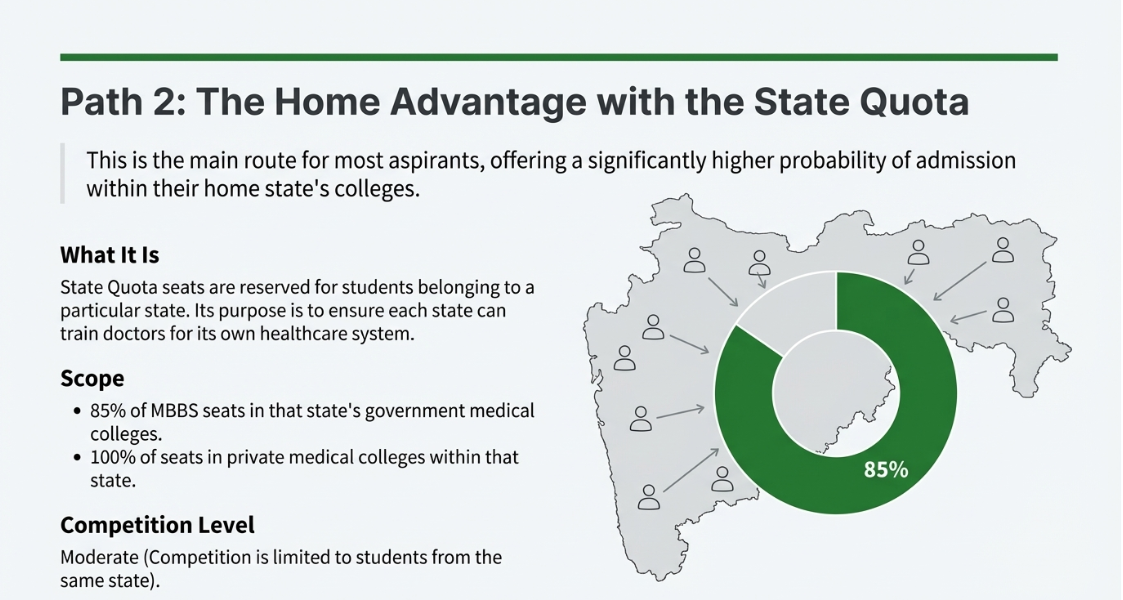
State Quota refers to medical seats that are reserved mainly for students belonging to a particular state. These seats allow students to take admission in government medical colleges located within their home state. The purpose of state quota is to ensure that each state trains doctors for its own healthcare system. State quota seats form the majority of government medical seats. Since competition is limited to students of the same state, cut-off ranks are usually lower than All India Quota. For many NEET aspirants, state quota is the most practical route to secure a government medical seat.
How many seats come under State Quota?
In government medical colleges, 85% of the total MBBS seats are reserved under the State Quota. These seats remain within the state and are not included in national-level counselling. In addition to this, 100% seats of private medical colleges within the state are also filled through state counselling. Because the number of seats is higher and the competition is limited to state students, the chances of getting a seat through state quota are generally better than AIQ.
Eligibility Criteria for State Quota Counselling
To take part in state quota counselling, a candidate must meet both national and state-level eligibility conditions. Unlike AIQ, state quota gives importance to domicile and local eligibility rules, which vary from state to state. A candidate must:
- Qualify NEET UG with the required cut-off score
- Fulfil the domicile or eligibility criteria of the state
- Complete online registration on the state counselling website
- Only candidates who meet state-specific rules are considered for government quota seats.
Read: Eligibility for NEET Counselling
How is State Quota Counselling Conducted?
State quota counselling follows a step-by-step online process conducted by the respective state authority. The counselling is limited to colleges located within the state and is conducted in multiple rounds to fill all available seats. The state counselling process includes:
- Online registration on the state counselling portal
- Choice filling and locking of colleges within the state
- Seat allotment based on rank and state rules
- Option to accept the allotted seat or upgrade in the next round
- Mop-up and stray vacancy rounds if seats remain vacant
AIQ vs State Quota: Understanding the Differences
AIQ and State Quota are two different routes through which medical seats are allotted after NEET. While both lead to the same MBBS degree, the competition level, eligibility rules, and counselling process are different. Understanding these differences helps students decide where to apply and how to plan their counselling strategy.
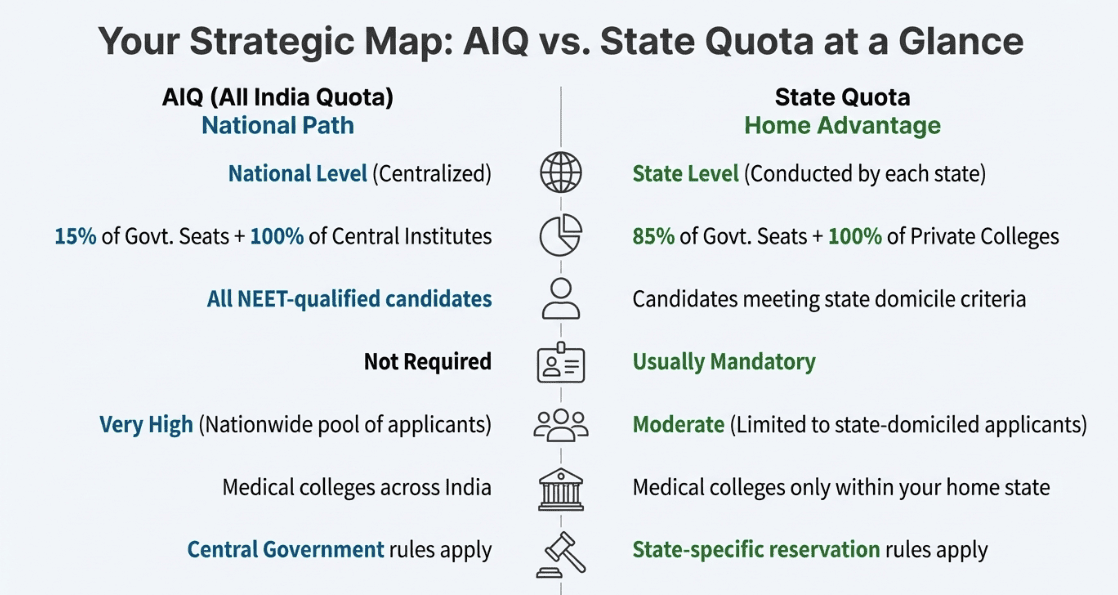
The main difference between AIQ and State Quota lies in who can apply and how seats are distributed. AIQ seats are open to students from all over India, whereas State Quota seats are mainly reserved for students belonging to a particular state. AIQ follows central rules, while State Quota follows state-specific policies.
| Parameter | AIQ (All India Quota) | State Quota |
| Level of counselling | National level | State level |
| Seats covered | 15% government seats + central institutes | 85% government seats + private colleges |
| Eligibility | All NEET-qualified candidates | State domicile candidates |
| Domicile requirement | Not required | Usually mandatory |
| Reservation rules | Central government rules | State-specific rules |
| Competition level | Very high | Moderate |
| College options | Across India | Within one state |
Can you apply for both AIQ and State Quota Counselling?
Yes, you can apply for both AIQ and State Quota counselling if you are eligible. Many students think that applying for one will cancel the other, but this is not true. Both counselling processes are separate. Applying for both increases your chances of getting a seat and gives you more options during different rounds.
Read: How to choose the right medical college during NEET Counselling?