How to Choose the Right Medical College During NEET Counselling?

NEET UG counselling is not just about getting an MBBS seat, but about choosing a place where you will study, live, and grow for more than five years. A wrong decision can affect your mental health, academic performance, and future plans. That is why college selection should be based on logic, research, and personal priorities rather than pressure or trends. Before filling choices, students should:
- Understand how counselling works
- Analyze their NEET rank
- Compare colleges as per comfort not based on reputation/trend
- Prioritize personal and academic comfort
Understanding NEET UG Counselling and Seat Quotas
NEET UG Counselling is the process through which MBBS and BDS seats are allotted to students based on rank, category, and preferences. Counselling happens through two main channels: All India Quota and State Quota. Each quota has different eligibility rules, cutoffs, and competition levels. Understanding these quotas clearly helps students decide where they have better chances of getting a seat.
- 15% All India Quota seats are open to students from all states.
- 85% State Quota seats are mainly for state domicile candidates.
- Central institutes like AIIMS and JIPMER come under national counselling.
- Private and deemed colleges have separate counselling rules as per state.
Before moving ahead it is important to clearly understand the Types of NEET Counselling.
Understand and Use NEET UG Rank Properly
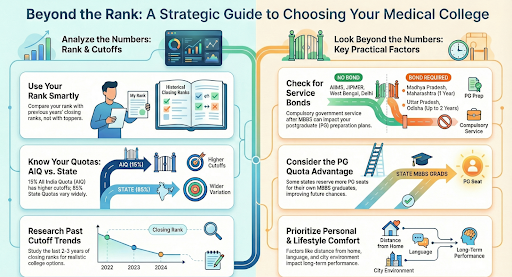
Your NEET All India Rank is the most important factor during counselling, but it should be used smartly. Instead of comparing yourself with toppers, compare your rank with previous years’ closing ranks of colleges. A proper understanding of your rank helps in building a strong preference list and avoids wasting choices on colleges that are out of reach.
How to use your rank effectively?
NEET cutoffs change every year due to factors like number of candidates, exam difficulty, and seat availability. In 2025, competition for government MBBS seats remained high because of limited seats and affordable fees. To understand where you stand, it is important to look at expected cutoff ranges for both All India Quota and State Quota together, instead of seeing them separately.
- Compare your rank with last year’s closing ranks.
- Check both AIQ and state quota cutoffs.
- Consider category-wise cutoffs if applicable.
- Keep backup options even if rank is good.
| Category | All India Quota (15%) – Expected Marks | State Quota (85%) – Expected Marks |
| General | 625 – 685 | 530 – 625 |
| General (EWS) | 622 – 682 | 575 – 625 |
| OBC | 595 – 615 | 555 – 595 |
| SC | 525 – 555 | 430 – 495 |
| ST | 520 – 545 | 425 – 485 |
How to Research Medical Colleges and Cut Off Trends Properly?
Researching medical colleges is more than just checking names on a list. You need to understand how cutoffs change every year and how competition differs from state to state. Cutoff trends give you an approximate idea of which colleges you can expect at your rank. For NEET 2025, general category government MBBS seats under All India Quota usually closed around the 20,000 to 25,000 rank range, while state quotas showed wide variation. While researching, focus on:
- Last 2–3 years’ closing ranks for each college
- Differences between AIQ and state quota cutoffs
- How far ranks moved in later counselling rounds
- Number of seats available in each category
A Look at the Previous Year’s NEET Cut Off Trends
Looking at previous years’ NEET cut off trends gives clarity about competition level. Over the years, the qualifying cut-offs have shown variations based on exam difficulty, number of candidates, and seat availability. From 2020 to 2025, the general category cut-off has remained on the higher side, showing increasing competition, while reserved category cut-offs have also shifted accordingly.
| Category | Percentile | NEET 2024 Cut Off | NEET 2023 Cut Off | NEET 2022 Cut Off | NEET 2021 Cut Off | NEET 2020 Cut Off |
| UR / EWS | 50th | 720 – 162 | 720 – 137 | 715 – 117 | 720 – 138 | 720 – 147 |
| OBC | 40th | 161 – 127 | 136 – 107 | 116 – 93 | 137 – 108 | 146 – 113 |
| SC | 40th | 161 – 127 | 136 – 107 | 116 – 93 | 137 – 108 | 146 – 113 |
| ST | 40th | 161 – 127 | 136 – 107 | 116 – 93 | 137 – 108 | 146 – 113 |
| UR / EWS (PwD) | 45th | 161 – 144 | 136 – 121 | 116 – 105 | 137 – 122 | 146 – 129 |
| OBC (PwD) | 40th | 143 – 127 | 120 – 107 | 104 – 93 | 137 – 108 | 128 – 113 |
| SC (PwD) | 40th | 143 – 127 | 120 – 107 | 104 – 93 | 136 – 108 | 128 – 113 |
| ST (PwD) | 40th | 142 – 127 | 120 – 108 | 104 – 93 | 135 – 108 | 128 – 113 |
Check: MBBS Bond in India 2025: State-Wise Rules, Duration & Penalties
Reputed Medical Colleges and Common Preference Order
Most students follow a commonly accepted preference order based on academics, patient load, exposure, and alumni strength. This hierarchy is not compulsory but helps in structuring the preference list logically. Central institutes and top government colleges are generally preferred because they offer strong academics, good clinical exposure, and better PG preparation environments. This order should always be adjusted based on personal priorities like location, language, and bonds.
| Preference Level | Colleges |
| Level 1 | AIIMS, JIPMER |
| Level 2 | MAMC, VMMC, UCMS, LHMC (Delhi colleges) |
| Level 3 | BHU, AMU, KGMU, other top central/state colleges |
| Level 4 | Top government medical colleges of your state (for example Calcutta Medical College) |
| Level 5 | Reputed private medical colleges |
Factors to consider while choosing the right medical college during NEET Counselling?
Choosing a college only based on reputation is not a wise idea. Practical factors affect daily life and long-term productivity during MBBS. Students must remember that they will live in the same city for years, manage academics, internships, and personal challenges there. Comfort and stability play a major role in academic success. Important practical factors include:
- Distance from Home: Choose a college that is not too far from home if you value family support or easier travel during festivals and emergencies. For example, students from Jharkhand may prefer colleges in neighboring states like West Bengal, Bihar, or Odisha for convenience.
- Connectivity: Good train or flight connections from your hometown make travel easier and less stressful. For instance, Kolkata is well connected to Ranchi, while some cities in Madhya Pradesh may have fewer direct connections from certain towns.
- Service Bond: Some states require rural or government service bonds after MBBS. Bihar, Jharkhand, West Bengal, and Delhi generally have no bond, while Uttar Pradesh and Odisha may have 2-year bonds, and Madhya Pradesh or Maharashtra may have 1-year bonds. Choosing a college with no or shorter bond gives flexibility for PG preparation.
- PG Quota: PG seat availability differs by state. States like West Bengal have higher PG quotas, offering better chances for desired specialties, while Bihar and AIIMS have lower or no state PG quotas. Considering this can help in planning your postgraduate path.
- Local Language: Comfort in patient interaction affects learning.
- Hostel/Mess & City Environment: Daily life comfort impacts overall performance.
- Patient Inflow: High patient load gives better clinical exposure.
Also Read: Common Mistakes to Avoid during NEET Counselling
Service Bonds: Meaning and Importance
Service bonds require students to serve in government or rural areas after MBBS for a fixed period or pay a penalty. Bonds vary from state to state and can significantly impact PG preparation plans. Some students prefer no-bond colleges to focus entirely on PG, while others are comfortable serving under bond conditions. Understanding bond rules before joining a college is extremely important. Students should also check:
- Penalty amount for bond breaking
- Posting location and conditions
- Whether bond applies to AIQ or state quota
| State/Institute | Bond Duration |
| AIIMS, JIPMER, BHU, AMU | No bond |
| Bihar, Jharkhand, West Bengal, Delhi | No bond |
| Madhya Pradesh, Maharashtra | 1 year bond |
| Uttar Pradesh, Odisha | Up to 2 years bond |
| Gujarat | No bond for AIQ, bond for state quota |
Importance of PG Quota While Choosing MBBS College
PG quota refers to the number of postgraduate seats reserved for students who completed MBBS from the same state. States with higher PG quotas provide better chances during NEET PG counselling. Many students choose colleges strategically to increase their future PG opportunities, especially after experiencing intense NEET UG competition. PG quota considerations are:
- States with higher PG seats offer better internal chances
- AIIMS have no state PG quota
- Some states have limited PG seats despite many UG seats
- PG quota provides security but does not guarantee selection
| State / Institute | PG Quota |
| AIIMS, JIPMER, BHU, AMU | AIQ students only |
| Bihar, Jharkhand, West Bengal, Delhi | High in WB, low in Bihar |
| Madhya Pradesh, Maharashtra | Moderate |
| Uttar Pradesh, Odisha | Varies |
| Gujarat | Moderate |
How to fill College Preference List?
Filling the preference list is the most critical counselling step because allotment depends entirely on this order. A well-planned list increases seat chances and avoids unnecessary upgradation stress. Students should never place a college they are unwilling to join, even as a backup option.
| List Type | Purpose |
| Dream List | Colleges slightly above your rank |
| Goal List | Colleges matching your rank |
| Safe List | Colleges where selection is almost certain |
Important Rules While Filling Preferences
- Always arrange colleges in the exact order you want, not based on chances alone
- Do not skip a better college thinking it may be allotted in later rounds
- Avoid filling colleges you are uncomfortable with due to location, language, bond, or fees
- Check eligibility for state quota and category before adding any college
- Lock choices only after reviewing them multiple times
For detailed guidance on counseling and seat allotment, check our NEET Counseling Guide or explore Top Government Medical Colleges.
📩 Email: info@collegeustad.com
🌐 Visit Our Website: www.collegeustad.com💬 Join Our WhatsApp Group:Click Here to stay updated with NEET UG 2025 news and counseling tips.
FAQs
Is choosing a medical college more important than just getting an MBBS seat?
Yes, because you will study and live there for over five years, which directly affects learning, mental health, and future plans
Should I choose a college only based on reputation or ranking?
No, practical factors like location, language, bonds, and comfort matter more than just the college name
Is it necessary to check previous years’ cutoffs before filling choices?
Yes, cutoff trends help you understand which colleges are realistic at your rank.
Are All India Quota cutoffs and State Quota cutoffs the same?
No, AIQ cutoffs are usually higher, while state quota cutoffs vary widely by state
Is it safe to rely only on Round 1 cutoffs?
No, you should also check Round 2 and mop-up round cutoffs for a better idea.
What is a service bond and why is it important?
A service bond requires compulsory service after MBBS and can affect PG preparation plans
Do AIIMS colleges have service bonds or PG quota?
AIIMS generally have no service bond but also do not offer state PG quota benefits.
Should I include colleges I don’t want as backup options?
No, never add a college you are not willing to join, even as a backup
What is the safest way to fill a preference list?
Create a Dream, Goal, and Safe list and arrange colleges in true order of preference
Does PG quota guarantee a PG seat later?
No, it only improves chances; selection still depends on NEET PG rank.